Get the selected value or text of an ASP.NET DropDownList with JavaScript or jQuery
A DropDownList is a <select> in the browser. The selected item has two pieces of information: its value (the value attribute, usually an id) and its text (what the user reads). Both are one property away, in plain JavaScript or in jQuery.
The control
<asp:DropDownList ID="ddlSize" runat="server">
    <asp:ListItem Value="" Text="-- size --" />
    <asp:ListItem Value="S" Text="Small" />
    <asp:ListItem Value="M" Text="Medium" />
    <asp:ListItem Value="L" Text="Large" />
</asp:DropDownList>
<span id="sizeInfo"></span>
Plain JavaScript
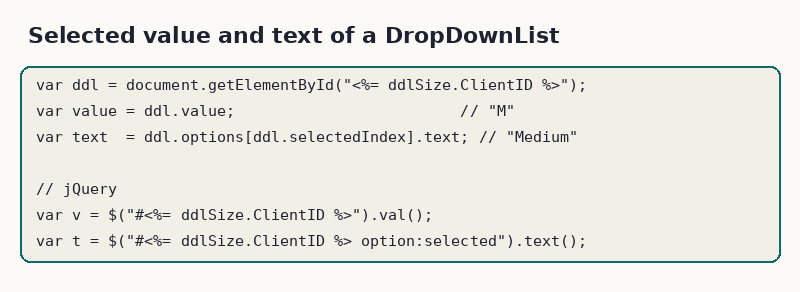
var ddl = document.getElementById("<%= ddlSize.ClientID %>");

var value = ddl.value;                                   // "M"
var text = ddl.selectedIndex >= 0
    ? ddl.options[ddl.selectedIndex].text                // "Medium"
    : "";
// In current browsers, also: ddl.selectedOptions[0].text
.text returns the option's text with white space collapsed; .textContent returns it raw. selectedIndex is -1 only when nothing is selected, which cannot happen in a normal single-selection list with at least one option, but the check costs nothing.
jQuery
var $ddl = $("#<%= ddlSize.ClientID %>");

var value = $ddl.val();                         // "M"
var text = $ddl.find("option:selected").text(); // "Medium"
Use $ddl.find("option:selected") rather than a global $("option:selected"), which would collect the selected options of every list on the page.
Reacting to a change
// plain JavaScript
ddl.addEventListener("change", function () {
  var info = document.getElementById("sizeInfo");
  info.textContent = this.value === ""
      ? "Please choose a size."
      : "You chose " + this.options[this.selectedIndex].text + " (" + this.value + ").";
});

// jQuery
$ddl.on("change", function () {
  var $opt = $(this).find("option:selected");
  $("#sizeInfo").text($opt.val() ? "You chose " + $opt.text() : "Please choose a size.");
});
textContent and jQuery's .text() insert the option text as text, never as HTML, which keeps the page safe even if option labels come from user data.
The placeholder item
A first item with an empty value such as "-- size --" is a common way to force a choice. Test the value, not the index or the text, to know whether the user picked something. On the server, a RequiredFieldValidator with InitialValue="" enforces the same rule, as shown in Validate a DropDownList.
Multi-select ListBox
An asp:ListBox with SelectionMode="Multiple" renders <select multiple>. Collect every selected option:
var lb = document.getElementById("<%= lbTags.ClientID %>");
var values = Array.from(lb.selectedOptions, function (o) { return o.value; });

// jQuery: val() returns an array for multiple selects (an empty array when nothing is selected, jQuery 3+)
var values2 = $("#<%= lbTags.ClientID %>").val();
On the server
The same information is available after a postback through ddlSize.SelectedValue and ddlSize.SelectedItem.Text. Do not rely on values read by script and copied into hidden fields: read the control itself and validate the value. Setting the selection from script is the subject of Set a DropDownList's selected value or text.
Official documentation
- MDN: HTMLSelectElement (
value,selectedIndex,selectedOptions), HTMLOptionElement.text - jQuery API: .val(), :selected selector
- Microsoft Learn: DropDownList class